- Date
- March 11, 2013
People facing life-threatening illnesses are deeply vulnerable: often in severe physical pain, worried about death, incapacitation, or the fate of their loved-ones. Much of this anguish is unnecessary. Palliative care effectively manages pain, treats physical symptoms, and offers psychological, social, and legal support for patients and families. Yet palliative care is often unavailable or inadequate, as policy makers and doctors prioritize prevention and curative treatment over quality-of-life care.
This report summarizes a June 2011 panel discussion organized by Human Rights Watch and the Open Society Foundations about human rights mechanisms that address the lack of palliative care. This side event at the United Nations Human Rights Council explored:
- the legal obligations of states;
- palliative care as key to the right of everyone to the highest attainable standard of physical and mental health;
- the failure to treat severe pain as cruel, inhuman or degrading treatment;
- best practices around human rights approaches to palliative care;
- the Human Rights Council’s enforcement mechanisms, and how it can work with international bodies to improve palliative care availability;
- opportunities for cooperation across regions to promote palliative care as a component of the right to health.
Participants included:
- Tabaré Vázquez, Director and Professor, Radiotherapy Service of the Department of Oncology, School of Medicine, La Universidad de la Republica; Head of Radiotherapy Services at the National Institute of Oncology, Uruguay Ministry of Health; former president of Uruguay;
- Diederik Lohman, Senior Researcher, Human Rights Watch;
- Liliana de Lima, Executive Director, International Association for Hospice and Palliative Care;
- Faith Mwangi-Powell, Executive Director, African Palliative Care Association;
- M. R. Rajagopal, Chairman, Pallium India.
Download
-
Access to Palliative Care: A Neglected Component of the Right to Health (733.29 Kb pdf file)
Download the complete 24-page report.
Read more
publication
Palliative Care as a Human Right: A Fact Sheet
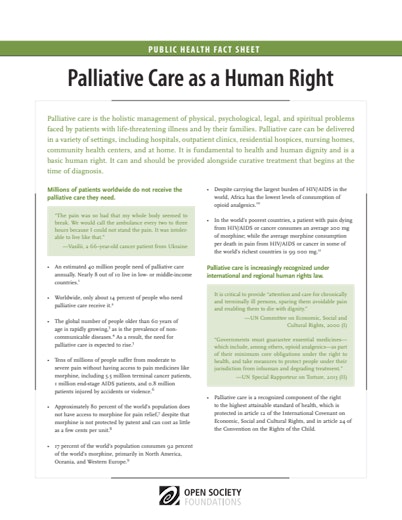
This fact sheet by the Open Society Public Health Program discusses palliative care as a basic human right. The fact sheet offers recommendations for governments to promote, protect, and ensure access to palliative care.
Voices In Depth
Inside the Archives: How George Soros Changed End-of-Life Care in America

The Project on Death in America ran from 1994 to 2003, with an ambitious goal: to transform the experience of dying in the U.S. Journalist Elizabeth Rubin spoke with Dr. Kathy Foley, the physician George Soros chose to lead it, to reflect on its impact.
Dignified End-of-Life Care
Governments Should Follow Moldova’s Lead and Ensure Universal Access to Palliative Care
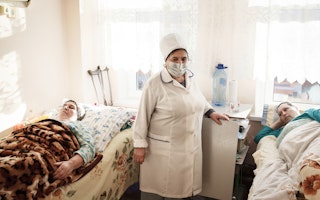
Over decades, Open Society’s funding for palliative care has improved access globally. However, while philanthropy plays a large role in this sector, palliative care must ultimately be publicly funded and universally available.