Subscribe to updates about Open Society’s work around the world
By entering your email address and clicking “Submit,” you agree to receive updates from the Open Society Foundations about our work. To learn more about how we use and protect your personal data, please view our privacy policy.
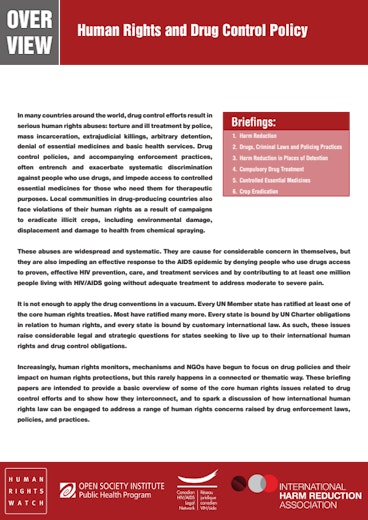
In many countries around the world, drug control efforts result in serious human rights abuses: torture and ill treatment by police, mass incarceration, extrajudicial killings, arbitrary detention, and denial of essential medicines and basic health services.
Drug control policies, and accompanying enforcement practices, often entrench and exacerbate systematic discrimination against people who use drugs—driving people with serious health needs further underground. In addition, people who experience chronic pain or who are living with debilitating illnesses are unable to get essential medicines such as morphine because of excessive restrictions put in place to control opiate drugs.
The Open Society Foundations, the International Harm Reduction Association, Human Rights Watch, and the Canadian HIV/AIDS Legal Network have created a series of fact sheets on the human rights implications of anti-drug policies and practices. The fact sheets provide detailed information on the following six topic areas:
Harm Reduction
Drugs, Criminal Laws, and Policing Practices
Harm Reduction in Places of Detention
Compulsory Drug Treatment
Controlled Essential Medicines
Crop Eradication
The fact sheets are available in English, Mandarin, and Russian.
Subscribe to updates about Open Society’s work around the world
By entering your email address and clicking “Submit,” you agree to receive updates from the Open Society Foundations about our work. To learn more about how we use and protect your personal data, please view our privacy policy.