In Nigeria’s ‘Food Basket,’ Communities Are Working to Break a Cycle of Violence
By Rommy Mom

With its lush green farmland, my home state of Benue has long been known as Nigeria’s “food basket.” Now it is becoming known for a new model of public safety developed by our communities. We believe it can help break a yearslong cycle of conflict and insecurity that has taken thousands of lives, displaced communities, disrupted livelihoods, and strained our trust in institutions.
The roots of the conflicts in Benue are multifaceted and include environmental factors: deforestation in northern Nigeria has pushed nomadic herders south into our communities in search of surviving grass. When disputes broke out between herders and farmers over destroyed crops, the lack of trusted, reliable policing allowed armed groups to exploit the tension.
This conflict has touched every part of our lives. We have lost thousands of our community members. In some areas, agricultural output has fallen by 70 percent as farms have been abandoned. Markets have closed; schools have been shuttered. The state’s response to attacks has been insufficient: temporarily send in troops, then place survivors into under-resourced displacement camps, where more than half a million people remain today.
In Benue, we’ve understood that lasting safety could not be achieved by force alone. Rather than give in to fear, neighbors in Benue are building a new model of public safety based on mutual trust, partnership, and accountability.
People-Centered Safety in Action
-
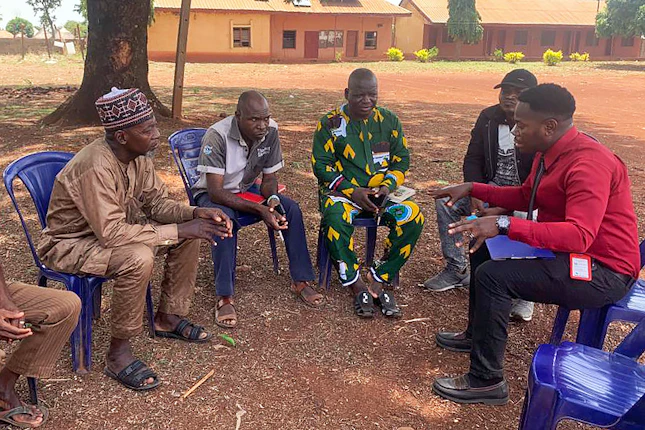
A community policing committee meets with religious leaders in Gbajimba, Guma Local Government Area, Benue State on August 21, 2024. Photo courtesy of Lawyers Alert -

A community policing committee meets with security agencies in Katsina-Ala Local Government Area, Benue State on November 12, 2024. Photo courtesy of Lawyers Alert -
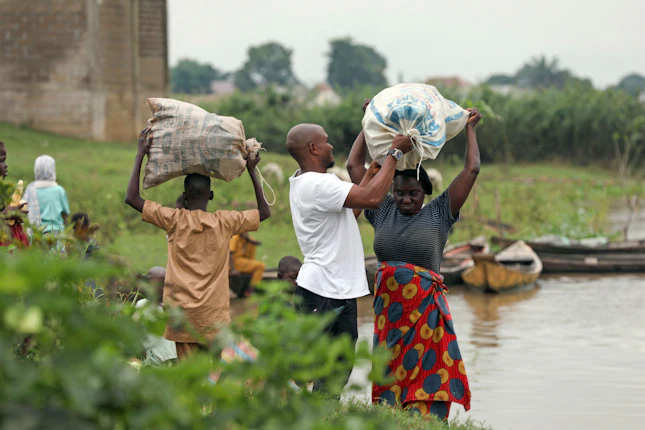
Farmers prepare to transport produce to a market in Benue State, Nigeria, on August 12, 2021. © Kola Sulaimon/AFP/Getty
Passed in 2020, Nigeria’s Police Act mandated the creation of community policing committees, or CPCs: platforms that bring law enforcement together with local communities to find solutions. No state had formally implemented them; working alongside local residents, we helped Benue become the first.
Benue residents already had a deep understanding of the drivers of violence in their neighborhoods. The CPC gave them a structured platform to come together, exchange information, and act. My colleagues and I at Lawyers Alert, a human rights nonprofit headquartered in Benue, supported the process from the background. As communities organized to select their own diverse representatives—women, farmers, youth, religious leaders, traditional rulers—we facilitated discussions around human rights principles, early warning signs of violence, and effective ways to engage with law enforcement. By providing logistical support and legal frameworks, we helped them connect with local police and state officials, who agreed to join the meetings.
The true power of the CPCs lies in mutual accountability. Communities have built a direct line to police leadership, and local officers are discovering that they are answerable to the people they protect. In one instance last year, when a police officer leaked the identity of a confidential informant, the local committee united to confront the police chief. Faced with an empowered community, the chief not only apologized but transferred and disciplined the officer—a level of community oversight that would have been unthinkable just a few years ago.
“Safety cannot be achieved by force alone, but through trust, inclusion, and cooperation between communities and the state.”
This newfound trust makes new forms of cooperation possible. In CPCs, local youth leaders have found a sense of purpose by becoming the eyes and ears for their communities; information they’ve shared at these meetings has helped authorities intercept attackers and prevent tragedies. In return, police are showing up more to the meetings to listen to concerns, explain their operations, and answer directly to residents.
For Benue’s communities, safety isn’t just the absence of an attack. As one local mother expressed at a recent meeting, safety is the ability for her children to walk to school and her freedom to fry bean cakes in the evening without harassment. A youth leader pledged to work with his peers to make that happen, and he kept his word—the kind of change that happens when neighbors form trust and work together.
A Model Beyond Benue
The work of the CPCs in Benue is spreading beyond its borders. Recently, several members organized a plan to travel into neighboring Taraba state, where many herders are from. They spent four days there speaking with authorities about ways to better manage herder routes. These were ordinary, unarmed civilians taking the initiative to cross state lines and find solutions for their children’s safety. It was an act of immense bravery that showed how fully the community had taken charge.In parallel, a cautious dialogue has begun between farmers and herders to explore peaceful coexistence. These conversations are still in their early stages, but in a region so long shaped by mistrust, they represent a transformative shift.
This model offers lessons for other regions facing similar challenges. In February 2026, Benue became the first state in Nigeria to formally adopt a people-centered model of public safety, built around our work in the CPCs. At the state government’s event launching the policy, there were guests from as far away as Colombia. Our conversations revealed shared understandings: that safety cannot be achieved by force alone, but through trust, inclusion, and cooperation between communities and the state.
The conflict is far from over, but there are signs of hope. In Katsina-Ala, we’ve seen shuttered markets come back to life. In Guma, some schools that closed and became displacement camps, have been reopened—because communities helped the government understand that safety means their children being able to learn. Turn on the radio, and you’ll hear CPC members sharing their knowledge, and people are listening. There are no shortcuts: trust is built incrementally, day by day and meeting by meeting. But with communities in charge, we can make real, gradual progress.
Lawyers Alert is a grantee of the Open Society Foundations.
Rommy Mom is president of Lawyers Alert, a nonprofit human rights organization operating in Nigeria, Cameroon, Ghana, Kenya, Malawi, and Zimbabwe.


