Neighbors Started Mutual Aid After the Beirut Port Explosion. Six Years On, They Haven’t Stopped.

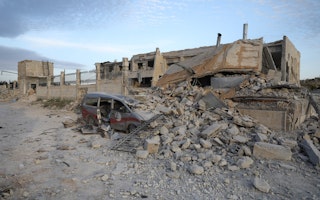
On August 4, 2020, a few minutes after 6 p.m., residents of Beirut’s Geitawi neighborhood found themselves stumbling down to the streets after a massive explosion at the Beirut Port—only two miles away—ripped through their homes. Shards of broken glass filled the streets, and fat plumes of smoke clouded the sky.
The blast killed at least 200 people, injured more than 6,000, and left hundreds of thousands of people displaced. It was later found to be among the largest nonnuclear explosions in history.
The next day, designer Josephine Abou Abdo and some of her neighbors gathered at an abandoned gas station on their street where they usually walked their dogs. They had nowhere else to go.
With no help coming from the state, they started organizing, turning the gas station into a distribution point for crowdsourced bottled water, fresh produce, nylon tarpaulins, and cooked meals. Everyone who lived nearby turned up seeking some form of assistance, especially Geitawi’s older population.
“From that point on, we grew organically and spontaneously,” Abou Abdo says, to a group of more than 200 volunteers, working together to distribute hot meals, donated clothes, and medicine.
The gas station became Nation Station. The carwash was turned into a community kitchen. A canvas spray painted in red was drooped over the station’s concrete canopy to announce the takeover.
Now six years later, its work has only grown.
“The needs are always evolving but, in a way, they also remain the same,” says Abou Abdo. “It’s somehow very similar to what we felt after the explosion.”
In 2024, as the war between Israel and Hezbollah destroyed homes and infrastructure across south Lebanon, the mutual aid group launched an emergency response, cooking more than 4,000 meals a day and sending them to shelters in Beirut and Mount Lebanon.
In 2026, as Israel has continued to launch attacks on southern Lebanon and other areas, triggering a mass displacement crisis that has overwhelmed state and international relief efforts, Nation Station distributed about 20,000 food packages a week to vulnerable households in heavily impacted areas, including the southern suburbs of Beirut and Sidon. In August, several weeks following the announcement of a U.S.-mediated fragile ceasefire and ‘framework agreement’ between Israel and Lebanon, Nation Station pivoted from mass emergency response to a sustained effort, continuing to distribute food parcels to families who have lost their homes and livelihoods.
Abou Abdo says the goal isn’t just to provide aid, but to empower people. The community center organizes “aperitivo nights,” which hand the space over to migrant and refugee community kitchens to serve specialty dishes; the proceeds subsidize the groups’ food distribution efforts. It has also offered social support services and educational workshops, on topics from nutrition to mental health to sexual health.
The dream is to build out a network: community kitchens from Tripoli to the south of Lebanon, each self-sustaining the way the one in Geitawi has become, using shared meals to start conversations around creating lasting change in the country.
“Unfortunately, every time we try to work on that, another big event or emergency happens,” says Abou Abdo. “It is very hard to plan in this country and in this situation.”
In the meantime, Nation Station continues to do what it has always done: show up for its communities.
“I can describe the city right now as tired and exhausted,” says Abou Abdo. “But there’s also hope in the air.”
Nation Station is a grantee of the Open Society Foundations.